


Conferences & Institutional Relations | Building relationships. Creating the conditions for business.
Leadership extends beyond internal operations
Industrial leadership is not confined to managing people, processes and financial performance. When circumstances require it, it also involves shaping the external conditions in which a company operates.
This broader responsibility rests on three considerations:
- Business performance depends partly on external conditions. Infrastructure, workforce capabilities, institutional relationships and the local industrial environment all influence competitiveness.
- Shared challenges require collective action. Dialogue among companies, including competitors, can identify common interests and address issues that individual businesses cannot resolve alone.
- Institutional engagement can deliver business value. Industry associations, professional forums and stakeholder relationships can strengthen a company's credibility, improve its operating environment and support its long-term development.
Such engagement is not an end in itself. It becomes relevant when it contributes to the company's objectives and broader industrial interests.
From business leadership to collective initiative
Foreign Investors Council — Buzău, Romania
In September 2002, Mauro M. Angelini initiated and helped establish the Foreign Investors Council in Buzău (F.I.C., also known as C.I.S. — Consiliul Investitorilor Străini).
Bringing together approximately twenty foreign-owned companies, the Council was created to provide a structured dialogue between international investors, local institutions and the regional business community.
Mauro M. Angelini was elected its first President, serving from September 2002 until the end of 2003.
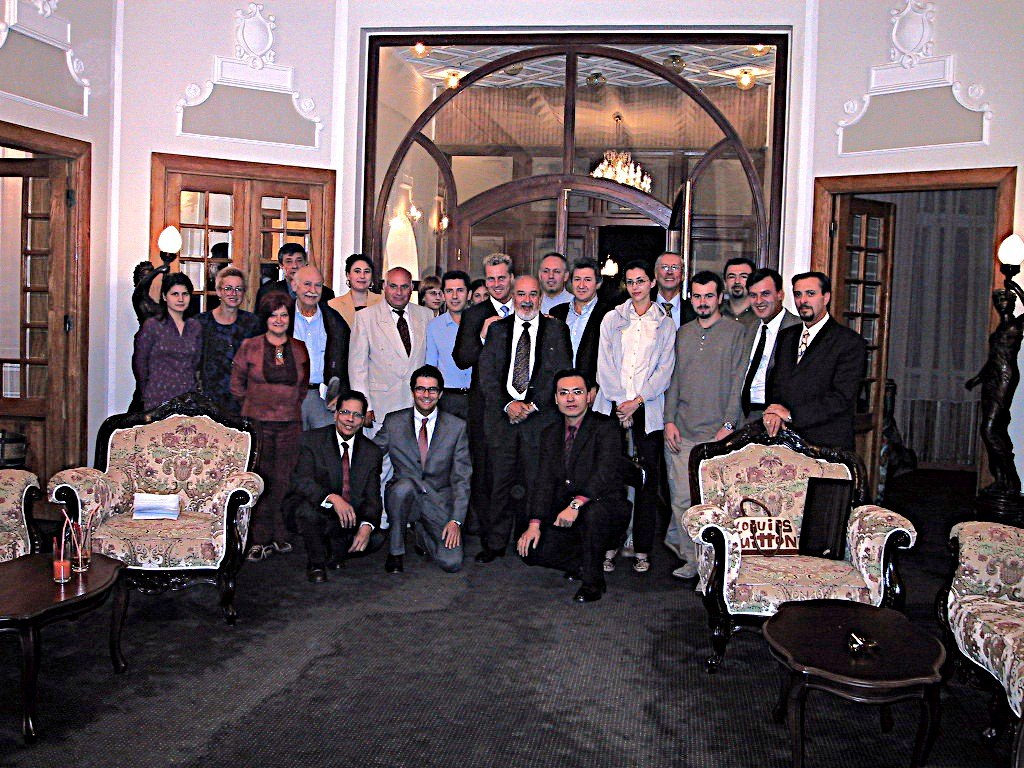
September 2002 — Mauro M. Angelini elected President of the Foreign Investors Council (F.I.C./C.I.S.) Buzău.
The initiative pursued three objectives:
- Represent shared business interests in discussions with public institutions.
- Encourage cooperation among international investors and local businesses.
- Promote practical initiatives addressing regulatory, employment and industrial issues.
Turning dialogue into action
On 12 February 2003, the Council organised a technical seminar on employment law, in cooperation with the Bucharest office of Studio Tonucci.
The seminar addressed the implications of Romania's new Labour Code for companies operating in the country.
The event brought together business leaders, legal professionals, public authorities and institutional representatives, providing an opportunity for discussion of regulatory developments affecting industrial operations.
Foreign Investors Council Buzău — Technical Seminar on Labour Law, 12 February 2003. English subtitles.
Extending institutional relationships
Business representation and industry associations
Alongside the Foreign Investors Council initiative, Mauro M. Angelini was involved in CPISC (Confederația Patronală a Industriei, Serviciilor și Comerțului din România), serving as its territorial President in Buzău.
These activities reflected a consistent approach: identifying common business interests and establishing channels through which companies could engage constructively with institutions and other stakeholders.
Unimpresa Romania
In July 2003, Unimpresa Romania was established in Bucharest. It would later become Confindustria Romania in 2011.
Martelli Europe participated in its foundation.
This development formed part of the broader evolution of Italian business representation in Romania, alongside the earlier, independently established initiative of the Foreign Investors Council in Buzău.
A continuing commitment to industrial dialogue
Over time, this experience extended to further institutional initiatives, conferences and business forums, including the Both World forums conceived by Mauro M. Angelini.
The underlying principle remained the same: business leadership can create value beyond the boundaries of an individual company when relationships, credibility and collective initiatives contribute to a stronger industrial environment.
Institutional engagement is therefore not a separate professional offering, but a responsibility that may complement executive leadership when business circumstances justify it.
